
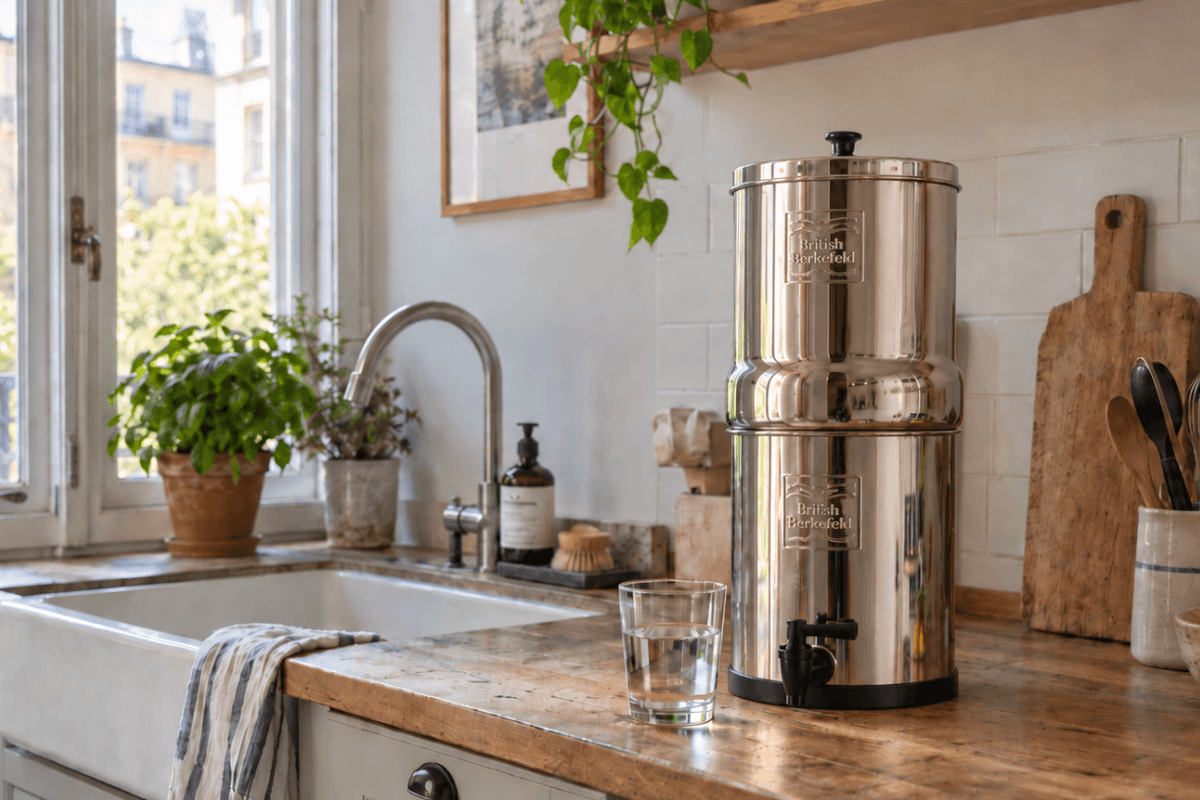
Between gravity systems, countertop filters, under-sink installations, filter bottles and the various cartridges available, choosing a water filter can quickly become complicated. The right approach is not to start with a brand or the size of the chamber, but with your water and how you use it.
Three questions before you look at products
A practical system fitted with a filter that is poorly suited to your water is not necessarily the right choice. Conversely, a filter that performs very well on paper can become unpleasant to live with if its installation, flow rate or maintenance do not suit your habits.
Step 1
Start by looking at your water
Not all water has the same characteristics. Depending on your municipality, your network, your building or your source of supply, the substances present can vary.
Before buying a filter just because it displays a long list of contaminants, check your water supplier’s analyses if possible, or have your water tested when the situation warrants it.
Taste, odour or chlorine
For compliant mains water whose taste bothers you, activated carbon can already meet much of the need.
Fluoride or arsenic
These contaminants require more attention. Look for elements with specific results rather than a simple “all-purpose” filter.
Metals, pesticides or PFAS
Compare the manufacturer’s tests, the concentration tested and, above all, the volume of water over which performance was measured.
Bacteria and particles
A genuine physical ceramic barrier can provide a different function from activated carbon: mechanically retaining particles and micro-organisms.
Step 2
Which filter element should you choose?
NiceWater offers several technologies. Some are very general-purpose, others address a more specific problem. Here is what really sets them apart.
Phoenix Gravity (New Millennium)
Broad-spectrum gravity filtration
The Phoenix Gravity elements are Berkey’s new main elements. They use a filtration media designed to reduce a very wide range of contaminants found in mains water.
Berkey claims a reduction in chlorine as well as in more than 200 common contaminants. Tests carried out by third-party laboratories also cover PFAS, including PFOA and PFOS.
Berkey recommends replacement after about 2,750 gallons per element, or roughly 10,400 litres, although the actual lifespan may be shorter with water that is particularly high in contaminants.
The Phoenix elements also initially reduce fluoride, by up to 75.5% in Berkey’s tests. However, the manufacturer points out that this capacity declines faster than the filter’s main performance.
See Berkey solutions →PF-2 Fluoride & Arsenic
A post-filter dedicated to fluoride and arsenic
The PF-2 is not a main filter element. It attaches beneath a main Berkey filter to add a stage specifically aimed at certain ions that are hard to adsorb.
Its media is based notably on activated alumina, used to reduce fluoride, arsenic V and pre-oxidised arsenic III.
Berkey now states that PF-2 filters can be used with Phoenix Gravity elements to extend fluoride reduction up to about 1,000 gallons, or nearly 3,785 litres.
However, this extra stage adds resistance to the flow of water and can therefore reduce the system’s flow rate.
See PF-2 filters →Ultra Sterasyl
Microfiltering ceramic + activated carbon + heavy metal media
The Ultra Sterasyl combines several functions in a single cartridge. Its ceramic shell acts as physical microfiltration, while its core contains activated carbon and a media designed to reduce certain heavy metals.
Doulton documents in particular the reduction of bacteria and cysts, chlorine, lead, microplastics and many pesticides, herbicides, organic compounds and pharmaceuticals.
Doulton states a typical gravity flow rate of about 1 litre per hour per element. Fitting several elements therefore increases not only the filtration surface but also the total flow rate available.
On the other hand, the Ultra Sterasyl is not the British Berkefeld cartridge designed for fluoride.
See the Ultra Sterasyl →Ultra Fluoride
Gravity ceramic with dedicated fluoride media
The Ultra Fluoride keeps the ceramic barrier used by British Berkefeld, but its internal media differs from that of the Ultra Sterasyl in order to give greater priority to fluoride reduction.
It also maintains performance on bacteria, cysts, chlorine and certain heavy metals such as lead.
In its in-house test with a nominal concentration of 1 ppm fluoride, Doulton claims up to 98.9% reduction and a total adsorption capacity equivalent to about 1,950 litres under these conditions.
The trade-off is important to understand: the Ultra Sterasyl is geared more towards certain organic and pharmaceutical contaminants, while the Ultra Fluoride gives more room to its fluoride media.
Coldstream FTO+
High-density ceramic + internal activated carbon media
The FTO+ works in two main stages. On the outside, a high-density ceramic shell acts as a submicron physical barrier: it retains particles and microplastics and helps protect against bacteria and other micro-organisms.
On the inside, Coldstream uses a granular activated carbon-based media developed to adsorb some of the dissolved contaminants: heavy metals, fluoride, pharmaceuticals, herbicides, volatile organic compounds and other chemical contaminants.
The performance data published by Coldstream include tests under the NSF/ANSI 42, 53 and P231 protocols. The results cover microbiology, various heavy metals and several families of chemical contaminants.
The published data show, for example, high reductions in lead, copper, cadmium and arsenic under the laboratory conditions used.
Coldstream states a rated capacity of 1,500 litres and recommends replacement at least every six months. For particularly difficult substances such as fluoride, you should always take into account how performance changes with the volume filtered.
See the Coldstream FTO+ →Coldstream MAX
Pressurised filtration for countertop and under-sink systems
Coldstream MAX filters also rely on ceramic filtration and internal media, but they are designed to work with mains pressure rather than gravity.
This difference matters: they are used in Coldstream countertop and under-sink systems and filter the water at the point of use, without filling an upper chamber.
Coldstream presents the MAX family as its highest-performing range of pressurised filters, with tests on bacteria, particles and microplastics, various chemical contaminants and, depending on the model, viruses.
Check compatibility: the different MAX models do not necessarily use the same cartridge format. Always check your housing model before ordering a replacement element.
See Coldstream solutions →Step 3
Then choose the format that suits you
Gravity system
You fill an upper chamber. The water then flows naturally through the filter elements before being stored in the lower chamber.
No plumbing, no electricity and an installation that is easy to move.
Countertop system
The system sits next to the sink and connects directly to the tap. Mains pressure pushes the water through the cartridge.
So it is not a gravity system, even though it remains visible on the worktop.
Under-sink system
The housing is installed under the worktop and fed by the cold mains water supply.
No chamber to fill and no bulky system visible on the worktop.
Filter bottle
Suited to work, commuting or travel when a small amount of water needs filtering at a time.
It usually complements a home system rather than replacing it.
Shower filter
A shower filter treats the water you use in the shower. It therefore meets a different need from filtration intended for drinking water.
The choice at a glance
Step 4
Don’t overlook the flow rate
It is a much less visible criterion than a reduction percentage on a data sheet, but it can completely change the everyday experience.
A filter you find tedious to use will often end up being used less.
A gravity system filters slowly by nature: it works without pressure and the water has to pass through the elements under its own weight alone.
The number of cartridges therefore has a direct effect on convenience. Two or four elements offer more filtration surface than one.
A countertop or under-sink system, on the other hand, uses mains pressure. Its actual flow rate is nevertheless lower than a fully open tap and depends on the available pressure, the cartridge fitted and its condition.
When the surface of a ceramic becomes loaded with particles, the flow rate can also gradually decrease.
If you regularly fill large jugs or cook a lot with filtered water, check the flow rate before buying, not just the filtration capacity.
Step 5
What capacity should you choose for a gravity system?
A large chamber does not necessarily filter better than a small one. Above all, it gives you more water between refills.
Ultra compact
For light use or when portability comes first.
Example: Go Berkey 0.95 L
Compact and portable
Suited to a small household, a flat, a holiday home or regular use on the go.
Examples: Travel Berkey · Pure Filters Voyager · British Berkefeld 6 L
The all-round size
A comfortable everyday supply without taking up a lot of space in the kitchen.
Examples: Big Berkey · British Berkefeld 8.5 L · Pure Filters Home
Family
Useful when several people use filtered water for drinking, cooking and filling their bottles.
Examples: Royal Berkey · British Berkefeld 12 L · Pure Filters Family
High consumption
For large households or heavy use throughout the day.
Example: Imperial Berkey
Groups and large reserves
For situations where a lot of water needs to stay available between refills.
Example: Crown Berkey
These figures are guidelines. A household’s actual consumption matters more than the number of people taken on its own.
What about camping or holidays?
Gravity systems have a particular advantage: they need neither electricity nor a permanent connection.
Smaller sizes are naturally easier to carry, but an 8, 9 or 12 litre system can still be moved when empty and is perfectly usable in a chalet, a holiday home, a campsite or during an extended stay.
The larger the system, the more it simply becomes a question of bulk.
7 questions before you buy
If you can answer these, the choice already becomes much simpler.
- Which substances appear in my water analysis?
- Does the filter really have results for these substances?
- Over what volume of water was this performance measured?
- Do I need a highly versatile filter or targeted filtration, such as for fluoride?
- Would I rather fill a chamber or filter directly from the mains?
- What flow rate is genuinely acceptable for my daily use?
- How often will the elements need cleaning and replacing?
Key takeaways
Choosing water filtration is not simply a matter of deciding between a small or a large chamber. Start by understanding your water, then choose a filter element whose performance matches your priorities, and finally select the format that suits your daily life. Flow rate, capacity, maintenance and the cost of consumables then help you decide between the remaining options.
Still unsure between several options?
Discover the systems available at NiceWater or contact us for help choosing based on your water and how you use it.